

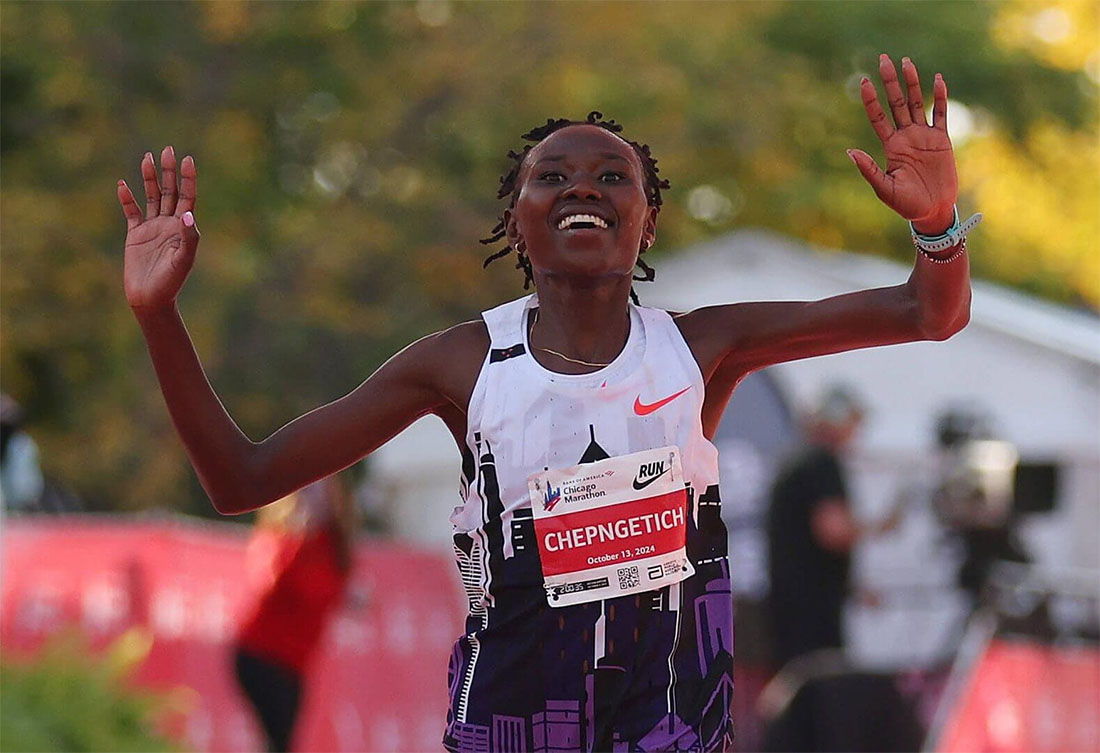
Photo Credit: Getty Images
Kenyan marathon star and reigning world record holder Ruth Chepngetich has been handed a three-year ban after admitting to an anti-doping rule violation involving the use of a banned substance. However, her record-breaking performance at the 2024 Chicago Marathon will remain valid, as it occurred months before the positive test.
The Athletics Integrity Unit (AIU) confirmed that Chepngetich tested positive for the banned diuretic hydrochlorothiazide (HCTZ) from a sample collected on 14 March 2025. The AIU’s statement revealed that the concentration of HCTZ in her sample was 3,800ng/mL — far exceeding the World Anti-Doping Agency’s minimum reporting limit of 20ng/mL.
Chepngetich, 30, made headlines in October 2024 when she ran an astonishing 2:09:56 at the Chicago Marathon, becoming the first woman in history to break the 2:10 barrier. The achievement was hailed as one of the most significant milestones in women’s athletics, further cementing Kenya’s dominance in global long-distance running.
Her provisional suspension was announced in July 2025. During an initial interview with AIU officials on 11 July, Chepngetich reportedly struggled to provide a satisfactory explanation for the presence of HCTZ in her system. Investigators examined her medications, supplements, and even her phone data in an attempt to trace the source of the substance.
The inquiry also uncovered WhatsApp messages sent to Chepngetich in April 2024 containing images of Testosterone and Oxandrolone — both banned anabolic steroids. The athlete claimed the messages were unsolicited and that she had not engaged with them, though she admitted to accidentally taking a screenshot.
Two weeks after her provisional suspension, Chepngetich changed her account, explaining that she had mistakenly taken medication belonging to her housemaid after feeling unwell. She later discovered that the drug contained hydrochlorothiazide, a diuretic used to treat high blood pressure and fluid retention. Such substances are banned because they can be used to mask other performance-enhancing drugs.
The AIU concluded that Chepngetich’s conduct was “reckless” and the result of “indirect intent” rather than deliberate doping. While the body initially sought a four-year sanction, her eventual admission earned her a one-year reduction, resulting in a three-year ban.
AIU head Brett Clothier emphasized that while the doping case related to HCTZ had been resolved, investigations would continue into the suspicious materials retrieved from her phone.
“The case regarding the positive test for HCTZ has been resolved, but the AIU will continue to investigate the suspicious material recovered from Chepngetich’s phone to determine if any other violations have occurred,” Clothier said.
Despite the suspension, the AIU confirmed that all of Chepngetich’s achievements and records prior to the 14 March 2025 sample date — including her historic Chicago Marathon run — would stand.
The decision means Chepngetich will be sidelined until 2028, missing several major competitions, including the 2026 World Championships and possibly the next Olympic cycle, depending on reinstatement procedures. Her case marks yet another high-profile doping scandal involving a top Kenyan athlete, renewing calls for stricter awareness and testing protocols in the country’s athletics programs.
Nonetheless, Chepngetich’s 2:09:56 record remains one of the most extraordinary performances in the history of women’s marathon running — a reminder of both her talent and the ongoing challenges facing the sport’s integrity.